
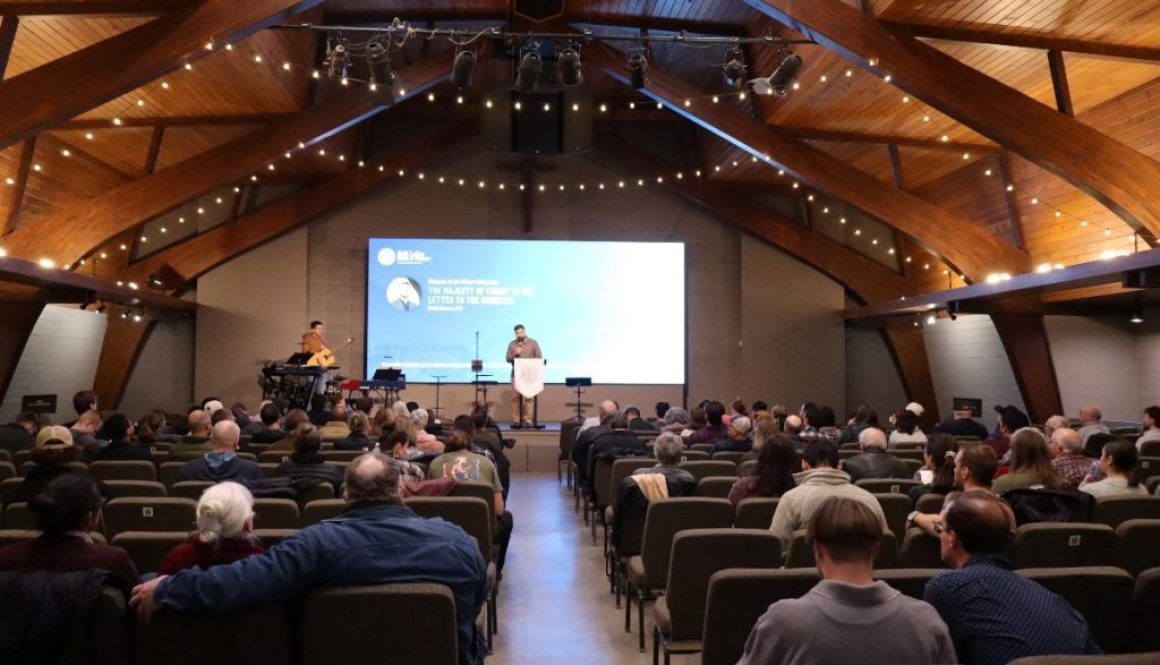
Hebrews lecture draws 125

By Karen L. Willoughby
SALT LAKE CITY – Jesus is alive! Today. Right now. The divinely human Jesus is alive in heaven, where He is sitting as He has the last 2,000 years-plus, at the right hand of His Father, Almighty God.
So says the Bible in at least 100 places – Romans 8:34, Mark 16:19, and even Psalm 110:1, plus 97 more – and so says Daniel Stevens, Ph.D. , an associate professor of New Testament Interpretation at Boyce College in Louisville, Ky., the undergraduate arm of The Southern Baptist Theological Seminary.
Stevens spoke Jan. 30 at a three-hour colloquium on the New Testament book of Hebrews. The event was hosted by Gospel Grace Church in SLC and sponsored by the Salt Lake School of Theology.
The lecture, preceded by a catered barbecue dinner, brought together about 125 people from Utah (with perhaps a few of them from Idaho.) Josh Lankford and his guitar led in the singing of Christ be Magnified.
Others have explored various Christian themes in Hebrews, such as five warnings against abandoning the faith, the call to endurance, and the theological development of the early church. For this lecture, at least, Stevens focused on “The Majesty of Christ.”
With his words anchored in the English Standard Version (ESV) of the Bible and the Greek New Testament, Stevens opened with a question: “Who does Hebrews say Jesus is?”

The author of Hebrews doesn’t identify himself and there is no greeting, Stevens said. He suggested one of Paul’s friends wrote it to Jewish believers about 70 A.D., or at least in the second half of the first century. “With the word ‘us’ in chapter two, [v. 3] the author connects himself with believers,” Stevens said.
“Jesus is God and man forever,” Stevens lectured. His focus in the opening lecture was on the nature of Christ, starting with Jesus’ true and full divinity (which he’s had since He created the world and will have throughout eternity;), and, since the incarnation – when he arrived as a baby born by Mary – His true and full humanity, which He also will have throughout eternity.
Stevens asked and then proceeded to answer questions:
- What did Jesus do? He made atonement for peoples’ sins.
- What does Jesus do? He intercedes for us as a priest, and sits as king. (Only kings could sit; everyone else had to stand, and to bow before the king.)
- What is Jesus’ role in salvation, according to Hebrews? He has two roles – king and priest – which “require the one person of Christ to have these two natures, and Hebrews’ explanations of Jesus’ priesthood and kingship don’t make sense without both [natures],” Stevens said.
After a short break Stevens talked about Jesus’ work.
- The story of Jesus’ work that undergirds Hebrews is the same as what is found in the rest of the New Testament and in the early creeds of faith, the “I believe in God the Father Almighty, maker of heaven and earth, and in Jesus Christ, His only Son, our Lord .…” The earliest creeds – statements of faith – date to 341 A.D.
- “Jesus works atonement in Hebrews, and that receives most of the focus, but He also does far more than priestly sacrificial atonement,” Stevens said, before listing several things Hebrews depicts Jesus doing.
- Among them, Jesus offered a new covenant, which established a closer relationship with God. He provided access to God’s presence. He advocates for believers. He sets the example for believers’ faith and obedience.
Stevens’ third lecture summarized the word of Jesus:
- Hebrews bases every claim on Jesus’ interpretation of the Old Testament Scriptures.
- The Scriptures are the Word of God.
- The Scriptures come from Jesus.
- The Scriptures speak about Jesus.
“Sometimes, Jesus speaks directly through the Old Testament scriptures in His proper person,” Stevens said.
Bottom line, people still today can, should, and do bow at the majesty of Jesus Christ, Stevens concluded. “When you look at Jesus, what you see is God. … When you talk about God, you’re talking about the Son,” he lectured.
Among other zingers Stevens injected into his lecture were these:
“What did Jesus come to do? Anything you can hope for, to reconcile you to God.”

“Sin does something to a person. It stains us, changes us; it’s a defilement. Jesus purifies us of our sin. Jesus purifies the inner self.”
“What is the role of the scriptures? They are the authority on doctrine and standard truth.”
“The writer of Hebrews teaches the Bible as if it were God speaking to us. To read the scriptures is to have God speak to you.”
Chris Hile coordinated the late January colloquium for the Salt Lake School of Theology.
“We consider an SLST colloquium to be a success when it equips Christians in Utah to know the Bible better, to grow in their love for God, and to equip them to be faithful followers of Christ in their everyday life,” Hile told UI Connections. “We believe that was the case this weekend, and we hope that these colloquia continue to provide opportunities for everyday Christians to grow in their understanding of the Bible and theology.”
Funds given through the UISBC’s York-Dillman State Missions Offering help Salt Lake School of Theology host seasonal events like these. The next colloquium is to take place in the Salt Lake City area in late August. More info to come in the months ahead.

Karen Willoughby

National correspondent for Baptist Press
and other state Baptist newspapers


